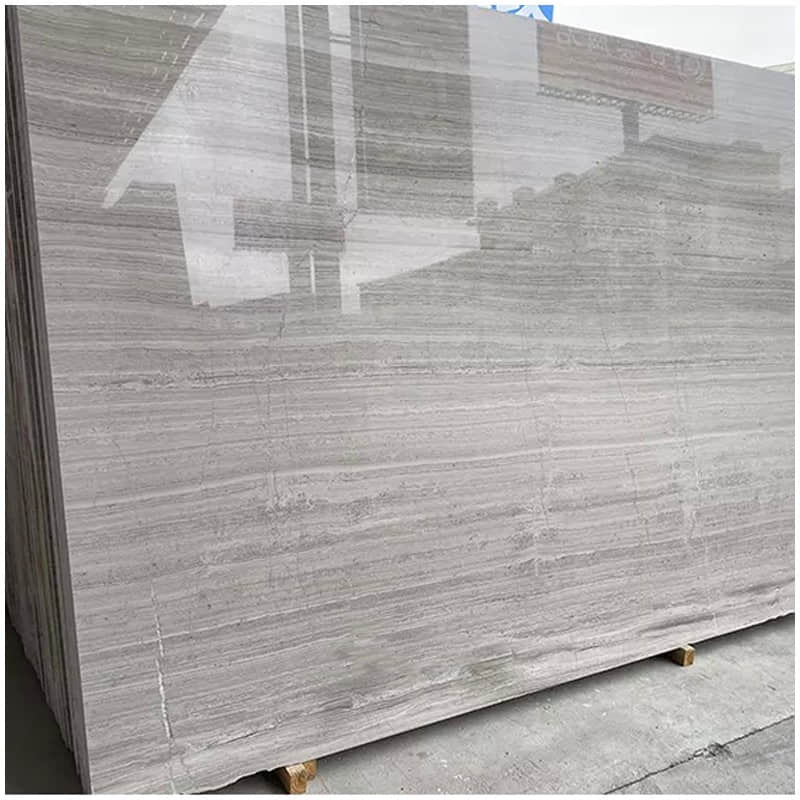
Specifying wood-grain marble (also known as wood-vein marble or Serpeggiante marble) for luxury hotel lobbies, executive feature walls, elevator enclosures, and upscale residential interiors offers architects a unique material option combining the warm, organic linear texture of natural timber with the structural permanence, cool tactile feel, and high polish of natural marble. Formed through fine-layered sedimentary calcite deposition, wood-grain marble features distinct parallel linear striations that mirror natural wood grain.
This technical sourcing guide evaluates wood-grain marble procurement, detailing geological sawing orientations (vein-cut vs. cross-cut), primary color spectrums, resin mesh backing reinforcement, book-matching protocols, surface processing options, and crate packing security for stone importers and project contractors.
Understanding these orientation and reinforcement rules allows procurement managers to specify calibrated wood-grain marble slabs that achieve seamless linear vein continuity across large feature wall installations.
Geological Slicing Orientations: Vein-Cut vs. Cross-Cut
The visual pattern of wood-grain marble depends entirely on how raw quarry blocks are sawn relative to natural bedding planes:
1. Vein-Cut Slicing (Linear Wood Grain)
Blocks are sawn parallel to their natural sedimentation layers. Vein-cut slicing exposes long, continuous linear stripes that perfectly mimic timber wood grain. This orientation is the primary specification for modern linear feature walls, door surrounds, and corridor floors.
2. Cross-Cut / Fleuri Slicing (Cloud-Like Flowing Patterns)
Blocks are sawn perpendicular or diagonal to bedding planes. Cross-cut slicing exposes cloud-like, swirling tonal variations with subtle floral movement, hiding linear directionality.
Primary Commercial Wood-Grain Marble Varieties
Wood-grain marbles originate from specialized quarry deposits producing distinct color fields:
Selecting a refined grey wood-grain marble slab provides a cool-toned, silver-grey linear field popular in contemporary office lobbies. For warm timber tones, specifiers choose a rich brown Serpeggiante slab featuring soft coffee and beige striping.
For crisp, luminous contrast, specifying a premium Athens wood-vein marble slab delivers crisp off-white and pale grey linear graining ideal for luxury hotel feature walls.
Book-Matching and Linear Vein Alignment Protocols
Reviewing an architectural book-matched feature wall guide clarifies how sequential slab bundling creates mirror-image symmetry across major focal walls:
Vein-cut wood-grain slabs are cut sequentially from single quarry blocks. When polished on alternating faces (Slab A polished on front, Slab B polished on back), adjacent slabs form continuous V-shaped or diamond book-matched patterns, transforming elevator lobbies and fireplace surrounds into striking natural art installations.
Vein Matching and Dry-Lay Inspection Protocols for Commercial Lobbies
Achieving seamless linear vein continuity across a 500m² hotel lobby elevation requires strict factory dry-lay inspection before crate packing. Slabs from sequential block bundles are laid out on factory floors under high-CRI lighting.
Technicians evaluate vein angles, background tone shifts, and resin-filled line alignment, numbering each slab in a grid matrix (A1 to D12) and tagging corresponding crate bundles to guide jobsite installers.
Floor Tile Layouts and Grain Orientation Strategies
When specifying wood-grain marble for commercial lobby flooring, interior designers must select between uni-directional straight laying or alternating quarter-turn basket-weave patterns. Uni-directional straight laying runs linear veins parallel to primary pedestrian traffic corridors, visually lengthening narrow entryways.
Quarter-turn layouts alternate horizontal and vertical vein tiles, creating a sophisticated woven wood parquet aesthetic across expansive reception areas.
Mechanical Properties and Resin Mesh Reinforcement
Wood-grain marbles possess distinct directional cleavage lines along natural vein layers. Physical properties should be verified per batch:
Physical Property Benchmarks (Test per Batch)
- Compressive Strength (ASTM C170 / EN 1926): Typically ranges from 75 MPa to 110 MPa, suitable for interior floor tiles and wall cladding.
- Flexural Strength (ASTM C880 / EN 12372): Ranges from 8.5 MPa to 13.0 MPa. Flexural strength is significantly higher parallel to grain layers than across grain lines.
- Water Absorption Rate (ASTM C97): Typically ranges from 0.25% to 0.55% by weight. High-density wood-grain marbles exhibit water absorption under 0.35%, making them suitable for bathroom vanity surrounds and floor tiles when sealed.
- Fiberglass Mesh & Epoxy Vacuum Netting: Due to natural linear fissures, raw slabs require full fiberglass mesh backing bonded with high-clarity epoxy resin under vacuum pressure to ensure flexural safety during handling.
Surface Finish Options for Wood-Grain Marble
Surface finishing alters the tactile depth of linear graining:
Polished Finish: High-gloss diamond polishing (gloss index > 85°) deepens color contrast between light and dark grain lines, creating a luxurious reflective face for lobby feature walls.
Honed Finish: Smooth satin matte finish (200 to 400 grit) that eliminates glare, providing a soft, natural timber-like feel ideal for bathroom flooring.
Brushed / Leathered Finish: Diamond wire brushes scour soft calcite layers along linear veins, producing a 3D tactile wood texture highly prized for modern accent walls.
Maintenance, Acid Protection, and Sealer Re-Application Cycles
Wood-grain marbles are calcitic natural stones that react with acidic substances (lemon juice, vinegar, or acidic bathroom cleansers). In luxury bath projects, specifiers must mandate factory application of high-performance fluoropolymer impregnating sealers. Maintenance teams should execute routine cleaning using soft microfiber mops and neutral pH stone cleaners, re-applying impregnating sealers every 12 to 18 months to prevent liquid absorption along linear vein layers.
A-Frame Steel Rack Export Packing and Slab Handling
Exporting 18mm jumbo wood-grain marble slabs requires specialized A-frame steel rack packaging inside 20ft heavy-duty containers. Slabs are loaded on edge against steel A-frames lined with continuous rubber cushioning strips, strapped securely with high-tensile polyester webbing. Inter-leaving plastic film placed between polished slab faces prevents face-scratching during 30-day ocean transit, while timber cross-bracing locks the A-frame racks in place inside the container shell.
Procurement Pitfalls and Quality Control Checklist
- Fissure Cleavage along Linear Veins: Inspect raw slabs for open fissures running parallel to grain lines. Ensure factory resin vacuum filling completely seals micro-cracks without color bleeding.
- Grain Angle Deviations: Specify maximum allowable grain slope angle (under 5 degrees off parallel) across 3000mm slab lengths to ensure straight vertical alignment on jobsite walls.
- Sequential Crate Bundling: Require factories to tag and pack slabs in exact cutting order inside A-frame crates to maintain vein flow during jobsite installation.
Frequently Asked Questions
Is wood-grain marble actual fossilized wood?
No. Wood-grain marble is 100% natural calcium carbonate marble. Its wood-like appearance is caused by fine-layered mineral sedimentation during geological formation, not fossilized organic timber.
Why are wood-grain marble slabs always reinforced with fiberglass mesh?
Because wood-grain marble features linear mineral layers, slabs can be brittle along natural grain lines. Applying a high-strength fiberglass mesh bonded with epoxy resin on the reverse face prevents slab cracking during transport and installation.
Can wood-grain marble tiles be used on heated bathroom floors?
Yes. Wood-grain marble tiles conduct heat efficiently, making them ideal for radiant floor heating systems. Installers should use flexible polymer-modified thin-set mortar to accommodate subtle thermal expansion.
What is the difference between vein-cut and cross-cut wood-grain marble?
Vein-cut slicing cuts parallel to natural bedding layers, creating straight, linear timber-like stripes. Cross-cut slicing cuts across bedding layers, exposing cloud-like, swirling floral patterns.


