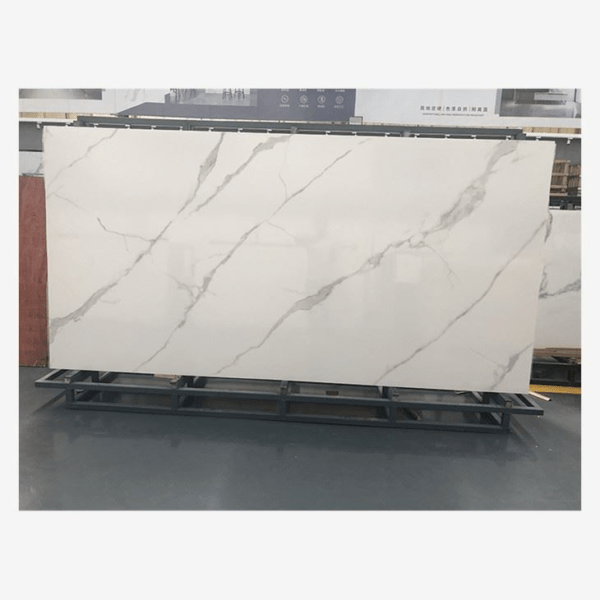
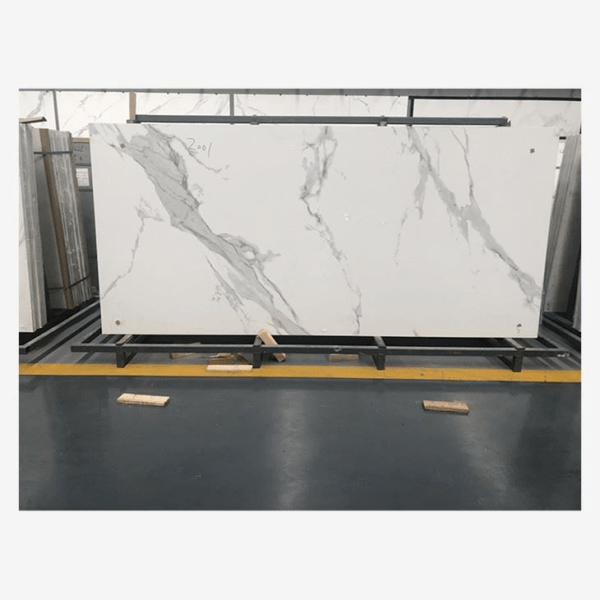
The surfacing market is currently defined by the competition between the "Authenticity" of natural stone and the "Engineered Consistency" of large-format porcelain and sintered stone. For architects and B2B procurement professionals, the choice is no longer simply about looks; it is about aligning material behavior with project-specific demands. Sintered stone and porcelain have revolutionized the industry by offering large, lightweight, and ultra-durable slabs that mimic the appearance of rare marble. However, natural stone remains the gold standard for luxury, heritage, and long-term material depth. This guide provides an honest, B2B-focused comparison to help buyers weigh the technical trade-offs and value propositions of both categories.
The Rise of Sintered Stone: Consistency and Performance
Sintered stone (often called large-format porcelain slabs) is a technological triumph. As detailed in the StoneTrades Product Knowledge v2 handbook, these materials are manufactured using ultra-high pressure (up to 400 bar) and extreme thermal firing (1200°C+). This process results in a slab with near-zero water absorption, making it virtually impervious to staining, scratching, and acid etching. For a commercial buyer, the "win" here is Batch Consistency. Every slab in a 1,000 SQM project will have the exact same color, pattern, and finish, drastically reducing the need for dry-lay inspections and material sequencing.
Porcelain also offers unique format advantages. Large 1600x3200mm slabs are available in 9mm or 12mm thicknesses, which are much lighter than 20mm natural stone. This makes them ideal for vertical cladding, cabinetry faces, and renovations where weight is a constraint. However, because the pattern is printed on the surface, the "body" of the tile is often a different color. A deep chip or a mitered edge will reveal the difference between the surface design and the internal matrix, a limitation that is not present in "full-body" natural materials.
| Feature | Natural Stone (Marble/Granite) | Sintered Stone / Porcelain | B2B Decision Factor |
|---|---|---|---|
| Authenticity | 100% Genuine; Unique depth | Engineered; Printed pattern | Luxury vs. Consistency |
| Absorption | 0.1% – 3% (Requires sealing) | Maintenance demand | |
| Consistency | High variation (Block-dependent) | Absolute (Batch-controlled) | Project scale risk |
| Repairability | Excellent (Re-polishable) | Poor (Chips show body; Unfixable) | Long-term lifecycle |
| UV Stability | Excellent (Natural minerals) | Excellent (Fired minerals) | Exterior suitability |
| Format | Standard 20mm / 30mm | Large, Thin (9mm / 12mm) | Weight and Logistics |
The Natural Stone Advantage: Material Depth and Repairability
Where natural stone wins is in its Perceived Value and Longevity. In a luxury hospitality or heritage project, there is no substitute for the genuine translucency of an onyx slab or the organic veining of a Calacatta marble. Natural stone possesses "material charisma"—it feels "alive" and ages with a graceful patina. Unlike porcelain, natural stone is the same material through-and-through. If a marble corner is chipped, it can be seamlessly repaired and re-polished. If a granite floor becomes dull after twenty years, it can be ground down and restored to its original luster. Sintered stone, once damaged or worn, must be replaced.
B2B specifiers also value the "Bookmatching" potential of natural stone. Because each slab is sliced sequentially from the same block, the veins can be mirrored to create stunning symmetrical patterns. While porcelain brands attempt to replicate this, the repetition of the print can lead to "uncanny valley" effects in large-scale installations. Natural stone is a 100% low-carbon material in its raw form, requiring only cutting and polishing, whereas porcelain requires energy-intensive firing. This sustainability profile is increasingly important for LEED and green-building certifications.
Buyer Framework: Aligning Material with Project Type
The choice between natural and engineered surfaces should be based on the project's "Risk vs. Reward" profile. Specify Sintered Stone/Porcelain for high-volume commercial developments (multi-unit residential, mid-market hotels) where budget predictability, stain resistance, and ease of installation are the priorities. The 9mm format is particularly efficient for cladding bathroom walls in 500+ units where weight and speed of install drive the ROI.
Specify Natural Stone for signature feature zones (lobbies, executive bars), custom luxury villas, and projects where the "authenticity" of the material is the primary asset. Natural stone is an investment in material depth. According to our manufacturing guides, the adoption of CNC 5-axis fabrication now allows natural stone to be carved into the same complex geometries as engineered surfaces, bridging the gap between traditional craft and modern design. Wholesalers should maintain a balanced inventory of both to meet the diverse needs of contemporary developers who often mix both materials within a single building.
Can sintered stone be used for exterior facades?
Yes. Sintered stone is exceptionally well-suited for exterior facades due to its UV stability and thermal shock resistance. However, the StoneTrades Product Knowledge v2 handbook recommends using 20mm slabs for high-performance facades to ensure sufficient structural "meat" for mechanical anchoring systems.
Is natural stone always more expensive than porcelain?
Not necessarily. While exotic marbles and quartzites are premium, commercial-grade granites and limestones can be price-competitive with high-end European porcelain slabs. The true cost difference often lies in the fabrication and installation labor rather than the material itself.
Does porcelain chip more easily than stone?
Porcelain is very hard but can be brittle, especially on the edges of thin (9mm) slabs. Natural stone, while sometimes "softer" (like marble), has a different internal tension and can be more resilient to edge-impact. Careful handling and proper substrate support are critical for both.
Which material is better for a professional kitchen?
For industrial-level heat and scratch resistance, both sintered stone and high-density granite are excellent. However, many chefs prefer granite because it is more "forgiving" for heavy equipment and can be repaired over time, whereas porcelain can suffer from permanent surface micro-cracking under extreme point loads.
When sourcing, B2B buyers should request the Slab Thickness Calibration data. Whether natural or sintered, a variation of more than +/- 1mm can cause major alignment issues. Ensure your supplier uses 5-axis CNC technology for all miters and cut-outs to guarantee the precision required for modern, high-precision architecture.