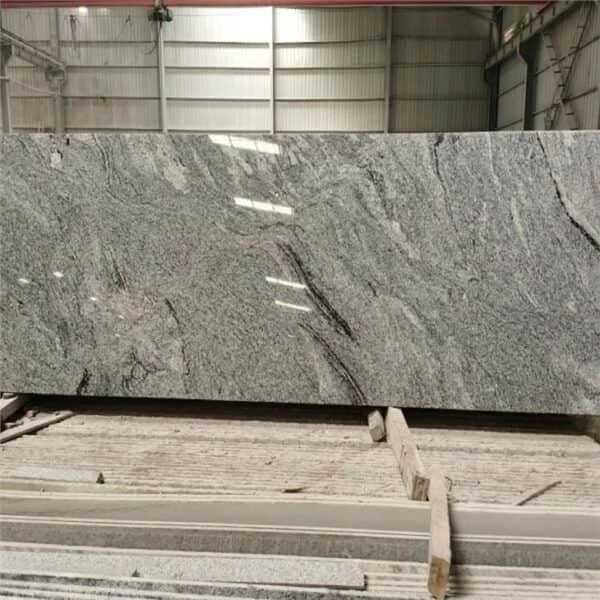
Procuring a natural stone with a veined, marble-like pattern for high-traffic environments requires evaluating materials that offer structural durability alongside visual movement. Viscount White granite represents a highly sought-after Indian gneissic stone, frequently specified for residential kitchen countertops and commercial wall cladding. Geologically classified as an intrusive metamorphic rock, this variety combines the mechanical strengths of a true silicate stone with the elegant flowing bands typically associated with carbonate marbles. Sourcing this material requires an understanding of its mineralogical characteristics, lot-to-lot variations, and fabrication parameters.
Geological Composition and Distinctive Gneissic Movement
Geologically, Viscount White is a gneissic granite formed under intense tectonic pressure and temperature conditions deep within the earth's crust. This metamorphic process caused mineral segregation, resulting in the stone's characteristic banded structure. The mineral composition is dominated by quartz, feldspar, biotite mica, and plagioclase. Quartz provides light grey translucency, while feldspars define the base white-to-light-grey background. Biotite and plagioclase form dark grey and black flowing vein streaks that sweep across the slab face.
The visual character of Viscount White features a cool pale grey-white ground crossed by these linear dark grey veins, with occasional deep burgundy or brown mineral spots. This makes it a popular choice for designers seeking a white marble aesthetic without the susceptibility to staining and etching. Unlike static speckled white granites, Viscount White offers dynamic sweeping movement. Slabs are processed with standard edge profiles such as eased, bullnose, or mitered edges to emphasize the flowing vein structure.
Sourcing managers must distinguish Viscount White from other white granites. For example, Alaska White features warmer flowing movement and larger feldspar crystals with prominent garnet flecks. Dallas White exhibits a fine, uniform speckling and static grain pattern that is highly consistent slab-to-slab. Viscount White sits in the middle, offering a cooler grey-white tone with sweeping linear veining. This distinctive pattern requires careful lot selection to achieve a balanced installation.
B2B Specification and Sourcing Standards
Viscount White is exported from Indian quarries and is available in standard thicknesses of 20 mm and 30 mm (verify per lot). Typical slab dimensions average 2800 mm by 1600 mm (verify per lot). Slabs are finished with a high-gloss polish for maximum color contrast, though honed and leathered finishes are available for a softer, low-sheen look. Slabs are secured in reinforced wooden A-frame bundles with steel straps for shipping.
Because it is a metamorphic gneissic stone, Viscount White commonly contains natural micro-fissures along mineral boundaries. Slabs are standardly resinned and mesh-backed with fiberglass and epoxy resin at the factory to ensure structural stability during transit and cutting. Fabricators must use CNC bridge saws or waterjet equipment to prevent edge chipping along these vein lines. Standard quality control inspections should check for complete resin curing and flatness tolerances of plus or minus 1 mm.
The material's physical stability simplifies the edge fabrication process. For commercial wall cladding or heavy-use countertops, confirming compressive strength and water absorption is recommended. Viscount White features low water absorption (typically below 0.35%, verify per lot), ensuring excellent stain resistance and durability in wet environments. Sourcing from quarries with stable benches ensures that the base color grade remains consistent throughout the project delivery.
Managing Lot Variation and Book-Matching Strategies
The flowing diagonal movement of Viscount White granite results in high variation from slab to slab. Background tones can shift from bright white to medium grey, and vein density can vary significantly between quarry blocks. Sourcing managers must enforce sequential slab selection. Slabs must be cut and numbered in sequence from the same block to ensure vein alignment at seams. Purchasing slabs by name without inspecting the actual bundles often leads to mismatched seams and high waste.
For large kitchen islands or wall cladding projects requiring book-matching, the vein flow must be matched visually. High-resolution photos of the full sequential bundle should be requested and approved before container loading. Conducting a dry-lay inspection at the factory allows the inspection team to arrange tiles or slabs by shade and ensure a smooth visual transition. Applying a solvent-based penetrating sealer is recommended during installation. The sealer fills mineral micro-pores, especially in the lighter feldspar bands, preventing oil and liquid absorption.
Re-sealing every 12 to 18 months (verify per lot) maintains the stone's stain resistance in high-use environments. Polished finishes are standard for maximum color depth, while honed or leathered finishes are specified for a softer, matte appearance. Importers should plan block allocations six weeks prior to fabrication to ensure color consistency across high-volume multi-unit projects.
| Granite Variety | Texture & Movement | Base Color Tone | Sourcing Price Tier | Best Sourcing Match |
|---|---|---|---|---|
| Viscount White Granite | Flowing, linear grey-black veins with minor burgundy flecks | Cool pale grey-white | Mid-range | Marble-look countertops and linear feature walls |
| Alaska White Granite | Heavy flowing chunks and large feldspar crystals | Warm cream-white | Mid-to-Premium | High-movement traditional kitchen islands |
| Dallas White Granite | Fine, uniform speckling and static grain pattern | Light grey-white | Budget-friendly | High-volume multi-family projects requiring consistency |
Frequently Asked Questions
Is Viscount White granite a true granite?
Yes, Viscount White is geologically classified as a gneissic granite. It contains the same durable silicate minerals as standard granite—quartz and feldspar—but went through metamorphic folding, giving it a veined appearance. It resists acid etching and scratching, making it highly durable.
How does Viscount White granite compare to Carrara marble?
Viscount White offers a similar white-and-grey veined aesthetic but is much more durable. Unlike Carrara marble, which is calcite-based and etches when exposed to acids, Viscount White is silicate-based, resists acid, has a higher Mohs hardness (6–7), and requires less maintenance.
Why is slab sequencing critical when ordering Viscount White?
Because it has flowing veins, the pattern varies between blocks. Ordering sequential slabs from the same block ensures that the veins align at seams during fabrication, reducing waste and ensuring visual continuity.
Indian factories supply Viscount White in standard 20 mm and 30 mm thicknesses; always request block-specific photos and execute dry-lay inspections at the factory to confirm the grey-vein density matches your design requirements.


