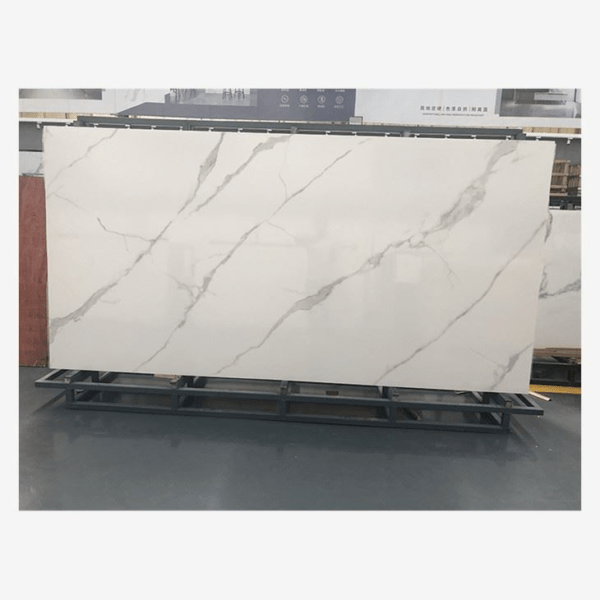
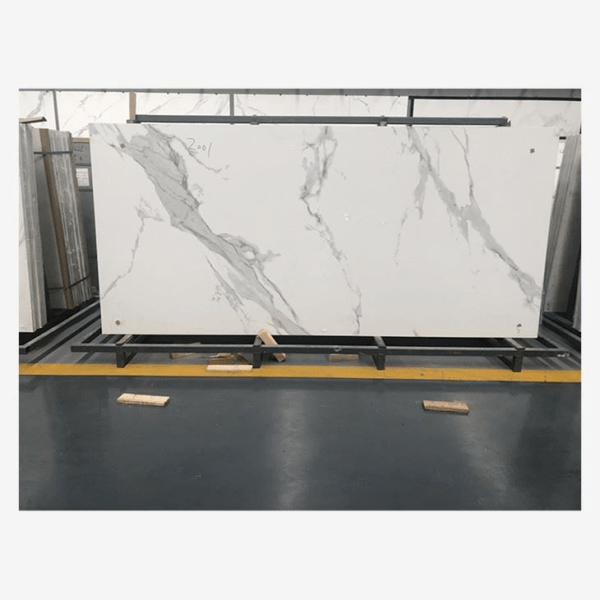
The sintered stone market in 2026 is on a confirmed growth trajectory, with multiple independent forecasts projecting CAGRs between 7% and 10.5% through the early 2030s. At the same time, the UNICERAMICS EXPO in Foshan this month saw manufacturers including NABEL present EPD-verified sintered stone lines directly targeting commercial countertop and facade specifications — product categories that have historically been natural stone territory. For procurement teams sourcing marble, granite, or travertine for high-specification interiors, the market shift is worth understanding on its own terms.
What the 2026 Growth Forecasts Actually Show
The numbers circulating in March 2026 vary by research firm — sintered stone market size estimates range from USD 293 million to USD 5.5 billion depending on how broadly the category is defined — but directional agreement is strong. Growth rates of 7–10.5% CAGR are consistently cited through 2030–2033. The porcelain slab segment, which overlaps significantly with sintered stone in end-use, sits at USD 12.4 billion and is projected to reach USD 21.85 billion by 2033 at a 6.5% CAGR.
Asia Pacific accounts for over 40% of global sintered stone revenue, driven by urbanization in China and India and by the concentration of manufacturing capacity in Foshan and surrounding Guangdong Province. Europe — particularly Spain and Italy — remains the primary hub for innovation and brand positioning, with producers like Dekton (Cosentino), Neolith, and Lapitec anchoring the premium segment. These are not niche players; they are now direct specification competitors to natural stone suppliers across facade cladding, countertop, and flooring categories.
Natural stone is not retreating. The global natural stone market is projected at USD 41.82 billion in 2025, growing at a 3.4% CAGR to 2034. Granite holds the largest share at roughly 32%, while marble is the fastest-growing type at a 5.78% CAGR. The two sectors are expanding in parallel — but sintered stone is growing faster, and it is increasingly being specified in project types where natural stone once faced no engineered competition.
Where Sintered Stone Competes with Natural Stone — and Where It Doesn't
The overlap is concentrated in specific application zones. Understanding those zones matters more than the headline growth numbers.
Sintered stone's strongest competitive claim is in applications that demand low maintenance, chemical resistance, and dimensional consistency at scale. Sintered stone is typically specified in thicknesses of 9mm, 12mm, and 20mm, with standard slab formats of 1600×3200mm. At 20mm, the material is rated for exterior facade cladding, laboratory countertops, and high-specification kitchen islands — specifications that have historically been filled by 20mm Calacatta marble or 18mm Absolute Black granite.
The performance differences are real. Sintered stone at 20mm resists thermal shock and surface etching that would permanently mark polished marble. It carries no porosity, so acid-based cleaning agents, wine, and citrus cause no damage. For a commercial kitchen or laboratory counter, that matters operationally. For a hotel lobby floor where Mohs hardness and vein pattern authenticity drive the specification, natural marble at 18–20mm still wins on aesthetics and on the story the material tells.
- Countertops (kitchen, bathroom, commercial bar): Sintered stone is gaining share. Price-sensitive or maintenance-averse buyers are switching. Luxury residential and hospitality projects are holding with marble and quartzite.
- Facade cladding: Sintered stone's UV stability and weathering resistance make it a direct competitor to granite and limestone panels. Thin panels (9–12mm) reduce structural load, which matters in retrofit projects.
- Flooring (heavy commercial): Sintered stone competes with granite and basalt for high-traffic public spaces. Natural stone still dominates where visual warmth and variation are specified.
- Wall cladding (interior): Both compete. Large-format sintered slabs (1600×3200mm) reduce grout lines and simplify installation — a practical advantage in hospitality projects with tight timelines.
- Furniture and decorative surfaces: Sintered stone furniture is a separate growing category (projected USD 2.5 billion by 2033). Natural stone furniture — marble dining tables, travertine coffee tables — occupies a distinct aesthetic niche that sintered stone has not displaced.
The honest read: sintered stone is winning on specification criteria where performance and maintenance dominate the decision. Natural stone is holding where origin narrative, colour variation, and material authenticity drive the brief.
What Buyers at Coverings 2026 Are Watching
Coverings 2026, running March 30 to April 2 at the Las Vegas Convention Center, is the largest tile and stone exhibition in North America and a reliable indicator of where specification is heading. Nearly 1,000 exhibitors from 40 countries are attending, with sintered stone producers including Dekton, Neolith, and Lapitec alongside traditional natural stone suppliers from Italy, Brazil, Turkey, and China.
The floor dynamics at Coverings have shifted over the past three years. Large-format sintered slab installations now occupy prominent positions in the same halls as Italian marble distributors. Architects and interior designers — the specifiers who ultimately drive purchasing decisions — are encountering both material families in adjacent stands, making direct comparisons on lead time, pricing, and surface finish consistency.
Lead times are one area where sintered stone has a structural advantage. Manufactured materials run on predictable production schedules; natural stone quarry output is subject to extraction limits, geological variation, and seasonal quarrying constraints. For a project with a 10-week installation window, a 16-week lead time for book-matched Calacatta Oro slabs may eliminate the option regardless of specification preference. That practical constraint is shifting some commercial project awards toward sintered alternatives — not because the designer prefers them, but because the programme requires it.
Sustainability Certification Is Now a Procurement Factor
The UNICERAMICS EXPO presentation by NABEL in March 2026 highlighted a trend that was less visible twelve months ago: Environmental Product Declarations (EPDs) are being used to differentiate sintered stone products in green building procurement. EPDs provide third-party verified lifecycle data compatible with LEED, BREEAM, and WELL rating systems. NABEL's EPD-verified sintered stone line is designed specifically to satisfy green building material documentation requirements that architects and developers are increasingly required to provide.
Natural stone suppliers are not without an argument here. Quarried stone is a natural material with a relatively simple supply chain compared to engineered surfaces that require high-temperature kiln firing and industrial binders. Some natural stone producers — particularly in Italy and Brazil — have begun publishing EPDs and carbon footprint data for their quarry operations. But the documentation infrastructure in the natural stone sector is less developed than in the ceramic and sintered stone industry, where ISO-standardised manufacturing processes make lifecycle analysis more straightforward to certify.
For procurement teams sourcing materials for projects targeting sustainability certifications, this gap is becoming a decision factor. A sintered stone supplier with an EPD on file is easier to document in a LEED submission than a natural stone supplier without one — even if the stone's actual environmental footprint is lower. Natural stone exporters who have not yet invested in EPD certification are operating at a growing disadvantage in specification-heavy commercial markets.
Buyers attending Coverings this week should ask EPD questions directly at natural stone stands. The answers will be a reliable indicator of how prepared a supplier is for the procurement processes that now govern major commercial and institutional projects.
Sources
- EIN Presswire — "UNICERAMICS EXPO Review: NABEL's EPD-Verified Sintered Stone Countertops"
- Infinity Market Research — "Global Sintered Stone Market Growth and Outlook"
- Business Research Insights — "Porcelain Slabs Market 2025 Size, Share Forecast 2035"
- IMARC Group — "Natural Stone Market Size, Share & Growth Analysis, 2034"
- Coverings — "Coverings 2026 Announces Annual Awards Programs"
- Verified Market Reports — "Sintered Stone Furniture Market Size, SWOT, Competitive Overview & Forecast 2033"