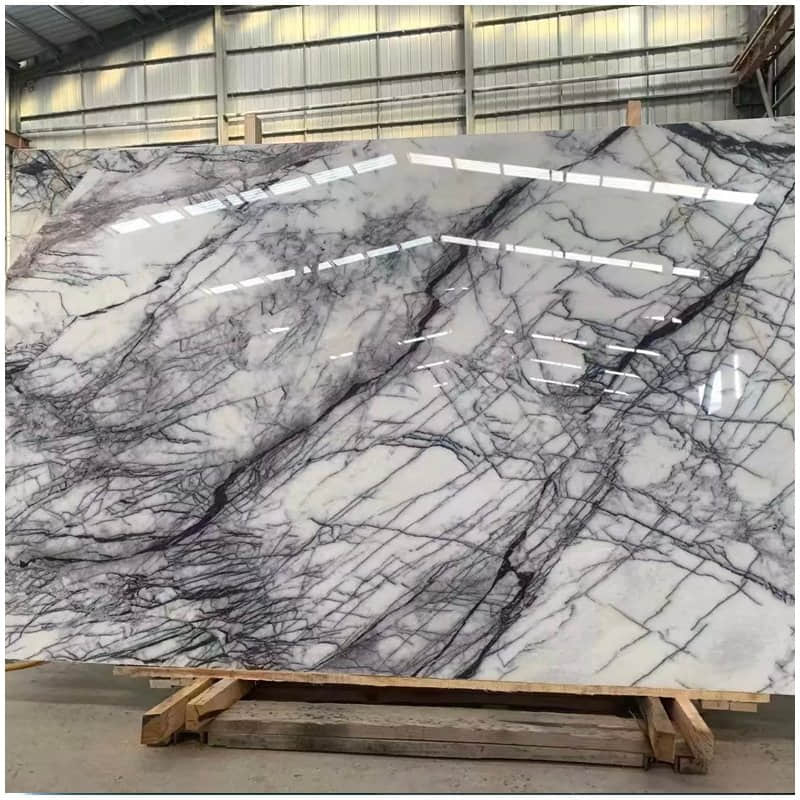
Surface texture selection serves as a critical junction between aesthetic intent and functional safety in architectural stone specification. Understanding natural stone finishes is essential because a material's geological origin determines its color and internal structure, while the mechanical finish applied during the final stages of manufacturing dictates its slip resistance, light reflection, and maintenance requirements. Understanding the technical nuances of these finishes—from the high-gloss clarity of a polished face to the rugged, thermal texture of a flamed surface—enables procurement officers to specify materials that align with the specific foot-traffic and environmental demands of a project. Whether addressing a high-traffic hotel lobby or an exterior plaza, the choice of finish is as foundational to the installation's success as the stone variety itself.
Natural Stone Finishes: The Polished Finish and Color Clarity
Achieving a polished finish involves a multi-stage mechanical process using progressively finer abrasive pads on an automatic polishing machine. This finish is characterized by a high-gloss, mirror-like surface that reflects light with maximum intensity, highlighting the intricate veining of materials like Carrara White or the deep crystalline structure of Black Galaxy granite. The polishing process closes the surface pores of the stone, which can marginally improve stain resistance; however, the lack of physical texture results in a low coefficient of friction, making it unsuitable for wet areas where slip hazards are a concern. In commercial settings, polished surfaces are typically reserved for vertical wall cladding, decorative feature walls, or low-moisture interior flooring.
Specifiers should note that a polished finish requires a high Mohs hardness value to maintain its luster. For instance, a polished Calacatta Gold marble with a Mohs rating of 3–4 will exhibit "traffic patterns" or dulling much faster than a polished granite with a hardness of 6–7. To maintain the 90-degree gloss level common in premium Italian marble, regular crystallization and maintenance with neutral cleaners are required. In high-traffic zones, the reflection will inevitably soften over time, leading many designers to consider a honed alternative for floor applications to ensure a more consistent appearance through the lifecycle of the installation.
Honed Surfaces: The Technical Balance of Safety and Aesthetics
A honed finish stops short of the final polishing stages, resulting in a smooth, matte surface without the high-gloss reflection. This finish is increasingly specified in "organic modern" and minimalist designs because it provides a velvety texture that feels softer to the touch. Technically, a honed surface provides a higher slip resistance (often reaching an R9 or R10 rating) compared to its polished counterpart, making it the industry standard for interior flooring in commercial buildings, kitchens, and bathrooms. Materials like Tundra Grey and Crema Marfil perform exceptionally well in a honed state, as the matte face hides minor scratches and etching from acidic spills more effectively than a reflective surface.
When specifying a honed finish for porous stones like Travertine or Limestone, the "filling" state must be considered. In Turkish Travertine, the natural voids can be left "unfilled" for a rustic look or "filled" with a matching resin or cement before honing to create a solid, durable surface. The degree of honing can also be customized; a "high-hone" provides a slight satin sheen, while a "low-hone" offers a completely flat, non-reflective appearance. This versatility allows architects to maintain color continuity across different functional zones by specifying the same stone in a polished finish for walls and a honed finish for floors.
Brushed, Sandblasted, and Flamed: Specialized Textures for Heavy Traffic
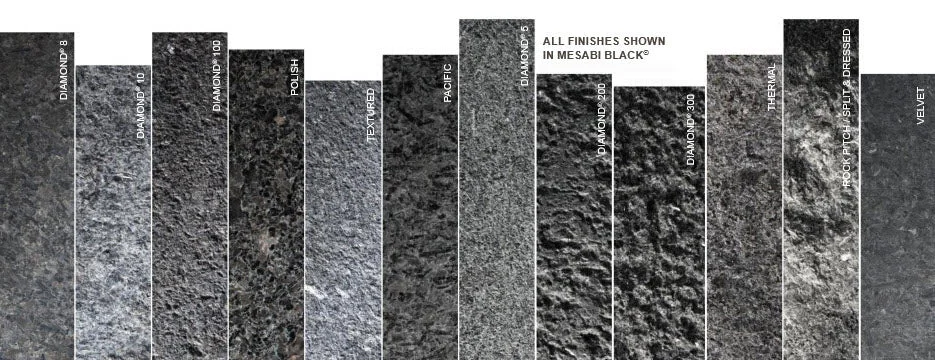
Textured finishes employ more aggressive mechanical or thermal methods to alter the stone's face. A brushed or "antique" finish is achieved by passing abrasive wire brushes over the stone, which wears away the softer minerals and leaves a slightly undulating, textured surface that mimics the look of naturally aged stone. This is a preferred finish for Pietra Grey or Black Slate, as it enhances the natural character while providing excellent traction. Sandblasted finishes, created by firing high-pressure silicified sand or steel shot at the stone, result in a uniform, granular texture that is highly slip-resistant. This is an ideal specification for high-traffic exterior walkways or stair treads where safety is the primary metric.
The flamed finish is unique to granite and other hard natural stones. It involves passing a high-temperature torch over the surface, causing the surface crystals to burst (thermal shock) and creating a rugged, non-slip texture. This is the standard finish for exterior paving and commercial plazas. However, for Sintered Stone or Quartz, thermal flaming is not an option due to the resin or vitrification process; instead, these engineered materials utilize digital texturing to mimic the flamed effect. For 20mm thick slabs like the JPA1632GA series, a "Velvet" or "Pleuche" finish provides a similar tactile response through mechanical abrasion, offering the benefits of a textured surface with the hygiene of a non-porous engineered stone.
| Finish Type | Recommended Application | Slip Resistance (DCOF) | Maintenance Level |
|---|---|---|---|
| Polished | Walls, Low-traffic Interiors | Low (< 0.42) | High (Scratches show) |
| Honed | Commercial Floors, Bathrooms | Moderate (> 0.42) | Medium |
| Brushed | Indoor/Outdoor Transition | High | Low (Hides wear) |
| Flamed | Exterior Plazas, Pool Decks | Very High | Low |
| Sandblasted | Public Steps, Ramp Areas | Very High | Low |
Technical Specification Criteria for Finish Selection
Selecting the correct finish requires a detailed assessment of the project's functional environment. In wet zones like spa floors or outdoor pool surrounds, a flamed or sandblasted finish is essential to meet building code safety requirements. Conversely, for a luxury kitchen island using Taj Mahal Quartzite, a polished or honed face is preferred to ensure ease of cleaning and food safety. The manufacturing process also impacts the lead time; while standard polished and honed slabs are typically held in stock, specialized finishes like "leathered" or "sandblasted" are often made-to-order (MTO), adding 2–4 weeks to the procurement cycle. Designers must also account for the fact that aggressive texturing can slightly mute the stone's color, making a "wet-look" sealer necessary if a deep color saturation is desired.
Which finish is most effective for hiding scratches in high-traffic areas?
Honed and brushed finishes are significantly more effective at concealing scratches and etch marks compared to polished surfaces. Because these finishes lack a mirror-like reflection, light does not bounce off the edges of micro-scratches, making them nearly invisible to the naked eye. For commercial projects using grey or black marble, a brushed finish is often the most durable choice for maintaining a pristine appearance under constant foot traffic.
Can a flamed finish be applied to all natural stones?
No, the flamed finish is generally restricted to granite and certain hard quartzites. The process relies on the stone's crystalline structure to react to thermal shock. Softer stones like marble, limestone, and travertine will crack or crumble under the heat of a flaming torch. For these softer materials, a sandblasted or acid-washed finish is used to achieve a similar non-slip texture without damaging the structural integrity of the slab.
Does a honed finish make the stone more susceptible to staining?
Technically, a honed surface is slightly more porous than a polished one because the pores remain "open" rather than being sealed by the final buffing stages. However, this risk is easily mitigated by applying a high-quality impregnating sealer. In a commercial context, the functional benefits of slip resistance and scratch concealment provided by a honed finish far outweigh the negligible increase in porosity, provided a proper maintenance schedule is followed.
How does sandblasting affect the color of the stone?
Sandblasting typically results in a "lightening" of the stone's appearance as the process creates a fine, granular texture that scatters light. A deep black granite may appear as a medium grey once sandblasted. If the project requires the deep color of the stone to be preserved alongside a non-slip texture, a brushed finish or a combination of flaming followed by brushing (to smooth the peaks) is a more suitable specification.
When placing an order for textured finishes, confirm whether the factory uses manual or automatic machinery, as automatic polishing lines ensure a more uniform texture across the entire batch. For large-scale projects, requesting a 30x30 cm sample of the exact finish on the target stone block is the only way to verify the tactile response and color shift before full production begins.


