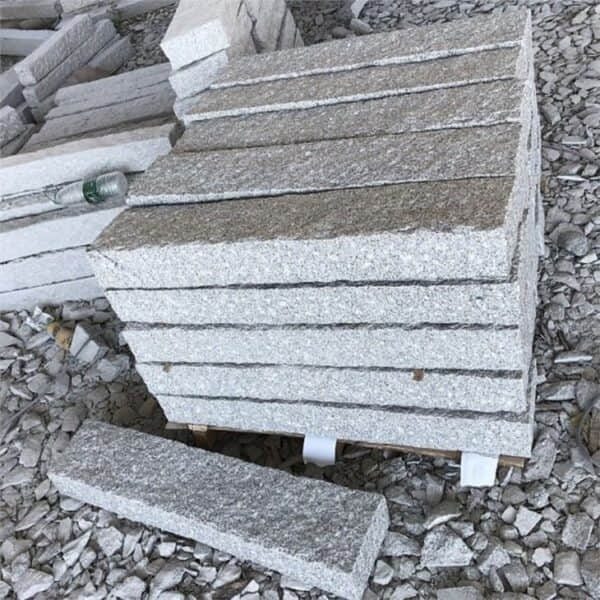
Granite kerbstones (curbstones) serve as the fundamental structural boundary for municipal roads, commercial highways, urban plazas, and public parks. Designed to contain road pavements, channel stormwater runoff, and protect pedestrian sidewalks from vehicular impact, granite edging far outperforms precast concrete in durability, impact resistance, and long-term life-cycle cost.
This sourcing guide outlines standard kerbstone profiles, surface processing options, mechanical performance criteria, installation practices, civil engineering standards, and B2B procurement standards for municipal contractors, landscape architects, and stone importers.
Key Advantages of Granite Kerbstones over Concrete Alternatives
While precast concrete kerbs are common in low-budget residential developments, civil infrastructure projects specify natural granite kerbstones due to distinct physical superiority:
- Extreme Impact Resistance: High compressive strength (>160 MPa) prevents chipping and shattering when struck by heavy commercial vehicles, buses, or snowplows.
- De-Icing Salt Immunity: Granite is chemically inert and unaffected by calcium chloride and sodium chloride salts used in winter road maintenance.
- Superior Freeze-Thaw Performance: Low water absorption (<0.3%) prevents internal moisture accumulation and spalling during harsh winter freeze-thaw cycles.
- 100+ Year Service Life: Natural stone kerbs can be salvaged, re-cut, and re-installed during road refurbishments, offering exceptional life-cycle economics over decades.
Standard Architectural Kerbstone Profiles
Kerbstones are manufactured in several standardized profile geometries depending on their functional placement along roadways and public realms:
1. Upright (Vertical) Kerbs
Featuring a 90-degree vertical face, upright kerbs create a strong physical barrier between vehicular carriageways and raised pedestrian footpaths. Standard dimensions are 1000x300x150mm or 1000x250x120mm.
Standard light grey G603 grey granite kerbstones are the industry workhorse for municipal streetscapes and commercial developments worldwide.
2. Battered and Beveled Kerbs
Battered kerbs feature an angled chamfer (typically 12.5 to 45 degrees) on the top front edge. This slope reduces tire scuffing and allows emergency vehicles to mount the kerb when necessary without damaging tires or wheel rims.
3. Radiused (Curved) Kerbs
Manufactured with precise concave or convex radii (from 0.5m to 12m radius curves) using multi-axis CNC wire saws to form smooth road junctions, roundabouts, and traffic islands.
4. Dropper and Transition Kerbs
Tapered units used to transition smoothly between high-upright pavement kerbs and flush pedestrian crossing points, ensuring ADA and barrier-free access compliance.
Surface Finish Options for Granite Edging
The chosen surface processing impacts both visual appearance and slip safety for pedestrians stepping on or off the kerb border:
Bush-Hammered Finish: The most popular commercial treatment. Carbide hammers create an even, non-slip textured finish. Sourcing bush-hammered grey granite kerbstones ensures uniform texture and high slip resistance along urban walkways and bus stops.
Pineapple (Fine-Picked) Finish: A heavily textured, rustic finish featuring deep, hand-chiseled pits (5mm to 10mm depth). Specifying pineapple finish granite kerbstones adds rugged architectural character to historic districts, public parks, and civic monuments.
Flamed Finish: Thermal flaming creates a medium-rough surface with a clean, modern aesthetic, ideal for contemporary commercial plazas and civic centers.
Sawn / Fine-Dressed Finish: Smooth sawn faces with lightly chamfered top edges, popular for sleek urban developments and indoor atrium edging.
Popular Granite Colors for Infrastructure Projects
Color selection for kerbstones prioritizes quarry capacity, batch uniformity, and cost-efficiency over rare decorative patterns:
Light grey granites lead global procurement schedules due to their high visibility and neutral tone. Specifiers frequently order Sesame White G603 kerbstones due to their consistent pale tone and reliable supply from high-capacity processing facilities. Dark grey granites (such as G654) and warm pink/grey options are also specified for decorative municipal borders and contrasting tactile paving lines.
Civil Engineering Standards and Testing
Municipal infrastructure contracts require compliance with stringent European (EN) and American (ASTM) standards:
- EN 1343 (Granite Kerbs for External Paving): Specifies requirements for bending strength (>12 MPa), water absorption (<0.3%), freeze-thaw resistance, and dimensional tolerances.
- ASTM C615 (Standard Spec for Granite Building Stone): Establishes minimum physical requirements including compressive strength (>131 MPa) and density (>2,560 kg/m³).
- Dimensional Tolerances: Standard manufacturing tolerance is ±3mm for length and ±2mm for cross-sectional profile dimensions to ensure straight alignment along road edges.
Quality assurance protocols for major civil kerbstone supply contracts require comprehensive factory testing prior to container dispatch. In addition to compressive and flexural strength verification under EN 1343, kerbstones undergo water absorption testing (EN 13755) and petrographic examination to ensure freedom from deleterious clay minerals or unstable iron pyrites that could impair long-term durability in severe climates.
Stormwater Channeling and Integrated Radius Gutters
Effective municipal roadway design relies on kerbstones working in tandem with specialized granite channel gutters and radius dished kerbs to convey surface runoff toward storm drainage catch basins. Integrated channel gutters placed along the kerb line prevent water ponding against asphalt road edges, reducing sub-base saturation and winter frost heave.
Installation Engineering and Foundation Detailing
Proper installation prevents kerb displacement under heavy traffic loads and snowplow impacts:
1. Concrete Haunching and Foundation
Kerbstones must be bedded on a continuous 150mm thick C20/25 concrete foundation bed. Once aligned, a 150mm concrete haunching is poured along the rear of the kerb to at least half its total height. Rear haunching absorbs lateral forces from heavy vehicle tires striking the kerb face.
2. Joint Clearance and Mortar Specifications
Kerbstones are installed with 5mm to 10mm open joints or filled with polymer-modified cement mortar. Movement joints (filled with flexible polysulfide sealant) should be placed every 12 to 15 meters to accommodate thermal expansion along long street runs.
3. Mechanical Vacuum Lifting Equipment
Because a standard 1000x300x150mm kerb weighs approximately 120 kg, modern installation crews utilize vacuum lifting attachments on mini-excavators. Vacuum lifting increases installation speed while eliminating manual handling injuries on site.
B2B Procurement and Packaging Standards
Because granite kerbstones are heavy, dense units, international logistics require robust packaging and container loading protocols:
- Hardwood Crating: Kerbstones are stacked horizontally in heavy-duty ISPM 15 certified timber crates, separated by wooden battens to prevent face scratching. Internal timber dividers and foam padding prevent end-to-end impact during crane loading and sea transit. Crates are stacked no more than two high inside 20ft heavy-duty shipping containers to prevent bottom crate crushing under dynamic vessel motion.
- Container Weight Optimization: Crates are loaded into 20ft heavy-duty shipping containers up to the maximum legal payload (27–28 metric tons).
- Pre-Shipment Inspection: Buyers should require pre-shipment photos of crate construction, strapping, and ISPM 15 heat-treatment stamps.
Frequently Asked Questions
Why are granite kerbstones preferred over concrete kerbs for municipal roads?
Granite kerbstones have superior compressive strength (>160 MPa), zero vulnerability to de-icing salts, and high impact resistance. While concrete kerbs crumble within 10 to 15 years under heavy traffic, granite kerbs last over a century with zero maintenance.
What is the standard length of a granite kerbstone?
The standard commercial length is 1000mm (1 meter). Custom lengths from 500mm to 1500mm can be manufactured for specific architectural layouts.
How are radiused granite kerbstones ordered?
Radiused kerbs are ordered by specifying the internal or external radius (e.g., R=1m, R=3m, R=6m) and whether the curve is concave or convex. Factories cut curved profiles using wire saws or multi-axis CNC bridge saws.
What bevel dimension is recommended for top kerb edges?
A 10x10mm or 15x15mm chamfered top front edge is recommended to prevent edge chipping during installation and reduce tire damage from vehicle contact.


