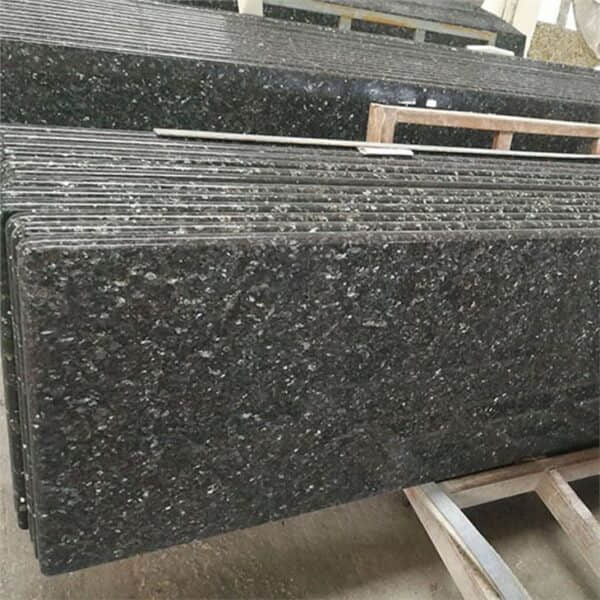
Emerald Pearl granite is one of the more recognisable dark granites in architectural procurement. Known across commercial stone markets for its deep, lustrous background and luminous green-to-turquoise optical reflections, this material occupies an established position in luxury commercial interiors, hospitality projects, and residential developments. Project specifiers and stone distributors frequently seek Emerald Pearl to deliver visual depth and prestige without sacrificing the structural durability expected from commercial igneous building stones.
Despite its commercial marketing designation as a granite, Emerald Pearl possesses a fascinating geological background that sets it apart from conventional quartz-rich granites. Understanding the petrological origin, crystal structure, and optical mechanics of this stone is essential for architects, interior designers, and stone buyers. Proper technical knowledge enables procurement teams to write precise specifications, evaluate factory slabs accurately, and avoid costly quality discrepancies during fabrication and installation.
This technical guide provides commercial buyers, fabricators, and project managers with a comprehensive overview of Emerald Pearl. The following sections explore the geological origin in southern Norway, the mineralogical mechanism behind its iridescent schiller effect, key distinctions from related stones such as Blue Pearl, surface finishing options, fabrication practices, and procurement quality control protocols.
Geological Origin and Mineralogical Classification
The authentic geological origin of Emerald Pearl is centered in southern Norway, specifically within the Larvik plutonic complex situated in the Vestfold region southwest of Oslo. Geologically, Emerald Pearl is classified not as a true geological granite, but as a larvikite, an intrusive igneous rock belonging to the monzonite family. Commercial stone markets categorize larvikite as granite due to its comparable density, high compressive strength, and excellent resistance to surface abrasion, but its mineral composition is distinct from silica-dominated granites.
Larvikite formed during an ancient Permian rifting event when molten magma cooled slowly deep beneath the Earth surface. This slow subterranean cooling process allowed large feldspar crystals, primarily ternary feldspars containing intimate intergrowths of orthoclase, albite, and anorthite, to crystallize within an augite and biotite matrix. The defining optical characteristic of Emerald Pearl is its labradorescence, commonly referred to in the stone trade as the schiller effect.
The schiller effect occurs when incident light penetrates the surface of the feldspar crystals and reflects off microscopic internal exsolution lamellae. These sub-microscopic mineral layers act as natural optical diffraction gratings, scattering light across specific wavelengths. In Emerald Pearl, this interference generates luminous green, emerald, and blue-green flashes set against a dark charcoal, olive-black, or deep greenish-gray groundmass. The intensity and distribution of these optical reflections give the stone its signature appearance.
Comparing Emerald Pearl and Blue Pearl Larvikite
Architects and procurement teams frequently compare Emerald Pearl with its famous geological sibling, Blue Pearl. Both stones originate from the Larvik complex in southern Norway and share identical monzonite lithologies, yet they display noticeable aesthetic differences:
- Optical Reflection Hue: While Blue Pearl displays predominantly steel-blue, silvery-blue, or royal-blue crystal reflections, Emerald Pearl exhibits distinctly green, emerald, olive, and blue-green iridescence.
- Groundmass Coloration: Blue Pearl typically presents a medium-to-dark blue-gray matrix, whereas Emerald Pearl typically shows a darker charcoal-black to greenish-black groundmass that provides greater contrast against its glowing crystals.
- Aesthetic Mood: Blue Pearl projects a cooler, contemporary metallic sheen suited for minimalist and maritime themes, while Emerald Pearl conveys an earthy, jewel-like tone that pairs effectively with rich wood veneers and warm metallic trims.
- Performance Characteristics: Both materials are generally dense and hard-wearing like other granites; project specifiers should check batch test reports for specific structural and load-bearing requirements rather than relying on generic stone assumptions.
Visual Characteristics and Batch Variations
As a natural quarry product, Emerald Pearl exhibits natural variations across different quarry benches, extraction blocks, and processing batches. Commercial buyers must understand these visual parameters to establish realistic acceptance standards with end clients:
Crystal Grain Size and Distribution
Feldspar megacrysts within Emerald Pearl can range from medium-sized grains to large, tabular crystals exceeding several centimeters in length. High-grade commercial slabs feature uniform crystal distribution across the entire face without vacant dark dead zones or excessive clustering that disrupts visual balance.
Background Matrix Tone
The base tone of the stone varies from deep olive-black to intense charcoal. Mixing slabs from different quarry benches within a single continuous installation can result in noticeable shade disparities.
Reflective Flash Density
The angle of crystal orientation determines how dramatically the slab illuminates under directed light. Slabs cut parallel to the primary crystal alignment display vivid, multi-directional iridescence, while slabs cut off-axis may show reduced flash intensity. Sourcing teams must require high-resolution dry-lay photographs and physical control samples before approving volume container shipments.
Surface Finishes and Optical Performance
The choice of surface treatment fundamentally influences how the human eye perceives the internal mineral structure of Emerald Pearl:
- Polished Finish: Polishing represents the primary and most celebrated surface treatment for Emerald Pearl. A high-gloss polish maximizes light transmission into the feldspar lamellae, producing maximum depth, clarity, and intense green schiller reflections. It is the preferred finish for commercial countertops, bar tops, and feature wall panels.
- Honed Finish: A smooth, matte honed surface diffuses incident light. While honing reduces specular glare and minimizes the visibility of superficial scratches in high-traffic commercial flooring, it subdues the optical flash into a subtle, low-contrast metallic glow.
- Leathered or Brushed Finish: Diamond-tipped abrasive brushes remove softer mineral components while leaving harder feldspar crystals in gentle relief. The resulting textured, satin-matte surface provides pleasant tactile qualities and enhanced slip resistance while preserving pleasant crystal shimmer under ambient lighting.
Commercial Applications and Fabrication Guidelines
Emerald Pearl serves diverse functional roles across upscale architectural and commercial building environments:
In high-traffic commercial interiors, installing durable Emerald Pearl granite tiles provides an exceptional combination of wear resistance and visual distinction for hotel foyers, corporate headquarters, and retail flagships. The stone resists foot traffic abrasion effectively, maintaining its appearance over extended service life.
In commercial hospitality and residential developments, fabricating a bespoke Emerald Pearl granite kitchen countertop or bar island offers good resistance to everyday scratching and, once sealed, to staining. Commercial developers frequently incorporate Emerald Pearl alongside broader selections from premium granite countertops collections to create tiered finishes across multi-family projects.
Specifiers must distinguish commercial larvikite from gem-grade labradorite building stones. While both materials display captivating optical iridescence stemming from feldspar twin lamellae, gem-grade labradorite belongs to the plagioclase series and is typically quarried in Madagascar or Canada as an exotic semi-precious stone with translucent peacock-blue sheets and higher micro-fissure density. In contrast, Norwegian larvikite provides the massive structural stability and uniform consistency necessary for large-scale architectural cladding; review the detailed labradorite stone guide to examine specific mineral differences and fabrication parameters.
Procurement Pitfalls and Quality Control
Procuring Emerald Pearl requires vigilant quality oversight to safeguard project budgets and design intent. Overseas buyers should enforce several essential factory inspection measures:
- Trade Name Ambiguity: Ensure purchase contracts explicitly specify Norwegian larvikite rather than generic green granites or chemically tinted stone substitutes that lack genuine feldspar labradorescence.
- Lighting Evaluation: Always evaluate production slabs under lighting conditions that match the final installation. The color temperature of ambient luminaires directly affects whether the crystal reflections appear distinctly emerald or muted charcoal.
- Resin Treatment and Fissure Integrity: Modern slab processing applies vacuum-assisted epoxy resin to stabilize natural microscopic relief fissures. Verify that the factory utilizes high-grade, UV-stable resins that will not yellow or cloud over time when exposed to interior perimeter sunlight.
- Full Slab Approval: Avoid approving production runs solely on small palm-sized hand samples. Hand samples cannot convey crystal density variations, background tone gradations, or localized resin patches across large slab dimensions.
Frequently Asked Questions
Where is Emerald Pearl granite quarried?
Emerald Pearl granite is quarried exclusively in southern Norway, primarily around the coastal town of Larvik in Vestfold county. The stone is extracted from massive igneous plutons that formed during the Permian geological era.
What is the difference between Emerald Pearl and Blue Pearl granite?
Both stones are Norwegian larvikites extracted from the same geological formation. Emerald Pearl features an olive-to-black groundmass with green, emerald, and blue-green iridescent feldspar reflections, whereas Blue Pearl possesses a blue-gray background with silvery-blue to royal-blue crystal flash.
Can Emerald Pearl granite be used for high-traffic commercial flooring?
Yes. Emerald Pearl exhibits the high hardness, low porosity, and abrasion resistance typical of dense igneous plutonic stones. In high-traffic commercial lobbies and corridors, a honed or leathered finish is often specified to provide reliable slip resistance while minimizing visible wear.
How should Emerald Pearl granite be sealed and maintained?
Emerald Pearl has relatively low natural porosity, but applying a premium penetrating impregnator seals microscopic micro-voids against oil and organic staining. Routine maintenance requires neutral stone cleaners, avoiding acidic detergents or harsh abrasive scouring pads that can dull the polished surface over time.


