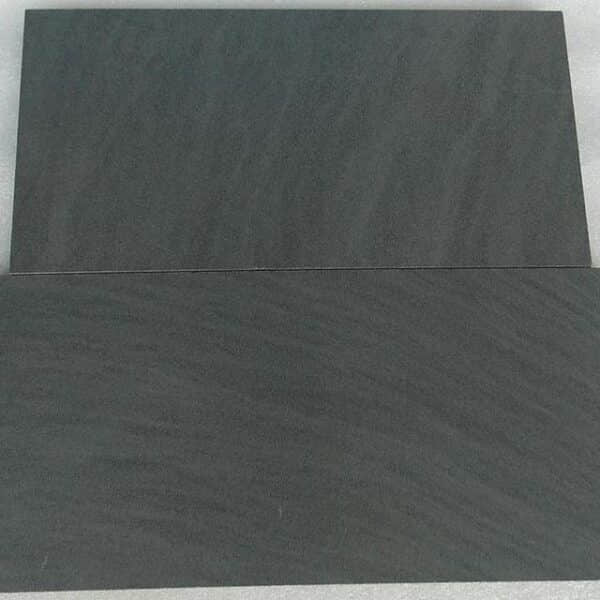
Sourcing black slate tiles for commercial interior flooring, exterior facades, and architectural roofing requires understanding slate petrology, manual cleavage splitting techniques, mechanical calibration, and mineral stability. Quarried extensively across premier deposits in China, Spain, Brazil, and the United Kingdom, natural black slate delivers a dense, charcoal-to-anthracite surface prized for its natural slip-resistant cleft relief, historic permanence, and tailored organic aesthetic.
The global commercial demand for black slate rests on its fine-grained metamorphic density, exceptionally low water absorption, and Class A fireproof performance. However, because slate splits along natural mineral foliation planes rather than being sawn on multi-wire diamond gangsaws, thickness calibration, edge squareness, and chemical mineral composition vary considerably between quarry benches. Low-grade black slates containing unstable iron sulfides can oxidize and delaminate over time, turning a pristine black floor into a rusted, spalling liability.
While our slate material general guide examines the broader spectrum of global slate varieties—including green, grey, purple, and multi-color autumn slates—this dedicated variety guide focuses specifically on natural black slate. Below, we detail cleavage splitting methods, thickness calibration standards, pyrite rust prevention, flooring and roofing applications, and export container packing protocols for B2B buyers.
Geological Formation, Foliation Splitting, and Surface Textures
Geologically, black slate is a fine-grained, foliated metamorphic rock formed through low-grade regional metamorphism of clay, shale, and volcanic ash deposits. Under intense tectonic compression, sedimentary clay minerals recrystallize into microscopic, parallel flakes of muscovite, sericite mica, chlorite, and quartz. This microscopic alignment produces slaty cleavage—the unique physical property that allows massive quarry blocks to be split cleanly along smooth, parallel sheets.
The characteristic deep charcoal to jet-black hue originates from finely dispersed carbonaceous matter and microscopic graphite particles trapped during the original sedimentation of organic muds. Depending on post-quarry processing, black slate is supplied in three primary surface textures:
- Natural Cleft (Riven Finish): Slabs are split by hand or pneumatic chisel along natural cleavage planes, preserving the authentic undulating texture, micro-ridges, and satin mineral luster of the stone. Natural cleft slate delivers superior slip resistance (R11 to R12 rating), making it the benchmark for wet areas, pool decks, and commercial entries.
- Honed / Calibrated Finish: The split slate is run through automated diamond calibration grinding heads to flatten surface ridges, followed by fine abrasives to yield a smooth, contemporary matte finish (under 20 GU). Honed black slate delivers a minimalist, architectural appearance for interior floor tiles and wall cladding.
- Brushed / Antiqued Finish: The natural cleft surface is treated with diamond-impregnated abrasive brushes that round off sharp cleavage edges, producing a soft, leathery texture comfortable for barefoot residential living.
Dimensional Specifications: Flooring, Wall Cladding, and Roofing
Managing thickness calibration is essential when ordering black slate for commercial projects:
- Gauged / Calibrated Floor Tiles: The underside of the tile is mechanically planed to a precise, uniform thickness (typically 10mm, 12mm, or 15mm with ±1.0mm tolerance). Calibration allows rapid, cost-effective installation using standard thinset mortar. Uncalibrated slate displays thickness variations between 8mm and 16mm across the same crate, requiring a labor-intensive thick mortar bed (30mm to 40mm thick) to level individual tiles.
- Standard Tile Formats: Modular commercial sizes include 300×300mm, 300×600mm, 400×400mm, 600×600mm, and 600×900mm, along with random rectangular French patterns for exterior patios.
- Roofing Slates: Cleaved into ultra-thin calibrated shingles (typically 4mm to 8mm thick) with pre-punched nail holes, engineered for overlapping exterior roof installations with design lifespans exceeding 75 to 150 years.
Black Slate Technical Specifications & Performance Benchmarks (Tested per Batch / Grade)
- Bulk Density (ASTM C121 / EN 12326): 2.70 to 2.85 g/cm³ (tested per batch; high mineral density indicative of advanced metamorphism).
- Water Absorption Rate (ASTM C121 / EN 12326): Under 0.15% to 0.40% by weight (tested per batch; Grade S1 roofing slates must test under 0.25%).
- Flexural / Bending Strength (ASTM C120 / EN 12326): 40.0 to 65.0 MPa along cleavage grain; 25.0 to 45.0 MPa across cleavage grain (tested per batch).
- Modulus of Rupture (ASTM C120): 45.0 to 75.0 MPa, demonstrating high resistance to foot traffic and roof snow loads.
- Slip Resistance (DIN 51130 / ASTM C1028): Natural cleft surfaces achieve R11 to R12 wet slip ratings; honed surfaces achieve R9 to R10.
- Acid and Environmental Resistance: Grade S1 black slate shows zero visible reaction or weight loss after immersion in standard sulfuric acid tests (EN 12326).
- Freeze-Thaw Resistance: Completely frost-proof through 100+ freeze-thaw cycles when water absorption tests below 0.30%.
Architectural Applications: Interior Flooring to Historic Roofing
Black slate provides continuous visual texture across high-traffic commercial environments. Specifying a calibrated black slate tile for luxury hotel spa wet rooms, steam suites, and vestibule entries ensures reliable wet slip resistance while creating a grounded, moody sanctuary atmosphere.
In high-traffic commercial facilities, installing large-format black slate floor tiles across airport retail corridors, restaurant dining halls, and corporate atriums provides long-term durability. Its dense crystalline matrix resists heavy foot traffic and rolling luggage wheels, while its dark charcoal color naturally conceals everyday dirt and tracking.
For architectural building envelopes, procuring certified non-fading black slate roofing tile units guarantees generational weather protection for luxury villas, civic monuments, and heritage restorations. Natural slate shingles resist severe hail impact, gale-force winds, and fire embers without degradation.
In landscape architecture, black slate pavers set on gravel or pedestal systems provide dramatic contrast against green lawns and swimming pool waters. The natural riven surface remains tactile underfoot and absorbs ambient heat without becoming uncomfortably hot to walk on.
Procurement Pitfalls: Pyrite Oxidation, Spalling, and Freight Crating
Importers should protect project investments by guarding against four common slate defects:
1. Reactive Pyrite (Iron Sulfide) Inclusions: The most catastrophic defect in black slate. Low-grade quarry beds contain unstable iron pyrite (FeS2) or marcasite crystals. When exposed to rainwater, humidity, and atmospheric oxygen, these reactive minerals oxidize into ferric hydroxide and sulfuric acid, causing bright orange-red rust streaks and structural delamination within months. Mandate European Standard EN 12326 or ASTM C406 testing: only Grade S1 / T1 / A1 certified non-rusting black slate should be accepted for exterior or wet specifications.
2. Thickness Inconsistency and Warped Backings: Uncalibrated slate tiles can cause severe floor lippage and trip hazards. Furthermore, some suppliers use cheap fiberglass mesh backings with water-soluble adhesives to strengthen fragile slabs; in wet installations, the glue dissolves, leading to tile debonding. Mandate mechanically gauged, mesh-free tile backs for wet areas.
3. Initial Cleavage Flaking and Surface Chalking: Freshly cleaved natural slate naturally sheds loose microscopic laminae (known in the trade as "slate dust" or initial spalling) during first-year use. Installers must wash and scrub the floor thoroughly after grouting, allowing the stone to dry completely before applying a breathable penetrating slate enhancer or natural oil impregnator to enrich the deep black color.
4. Freight Crating and Edge Spalling Prevention: Slate tiles are thin and brittle along perimeter edges. Packing tiles flat inside crates will cause extensive corner fractures during ocean shipping. All slate tiles and roofing shingles must be packed vertically on edge inside heavy-duty, fumigated ISPM-15 certified wooden crates. Crates must be tightly packed with corrugated cardboard interleaving, wrapped with waterproof plastic film, and secured with tensioned steel bands inside 20-foot containers.
Frequently Asked Questions
How can buyers distinguish between non-fading and fading black slate?
Non-fading black slate contains stable carbonaceous pigment and no reactive carbonate or iron sulfide minerals, retaining its deep black color for decades under direct solar exposure. Fading black slate contains microscopic calcite or iron inclusions that oxidize or dissolve upon outdoor weathering, turning the stone into a dull chalky grey. Request certified ASTM C406 (Grade S1) or EN 12326 documentation to verify non-fading status.
Does black slate require a topical sealer or a penetrating impregnator?
Always specify breathable penetrating impregnators rather than topical acrylic film-forming sealers. Topical sealers trap moisture beneath the stone, peel under UV exposure, and scratch easily under foot traffic. Penetrating solvent-based impregnators absorb deep into the micro-pores, repelling water and oil stains while enriching the dark graphite tone without forming a slippery plastic film.
What is the difference between calibrated and uncalibrated black slate tiles?
Calibrated black slate tiles have their undersides mechanically planed to an exact uniform thickness (such as 10mm or 12mm), allowing rapid installation with standard thinset mortar. Uncalibrated tiles feature natural split textures on both sides with thickness variations of 4mm to 8mm, requiring a labor-intensive thick mortar bed to install evenly.
Can black slate tiles be installed over electric underfloor heating systems?
Yes. Black slate possesses excellent thermal conductivity and high thermal mass, making it an ideal covering for hydronic or electric radiant underfloor heating. The stone heats up evenly, retains warmth long after the system shuts off, and expands and contracts stably without cracking when installed with flexible polymer-modified thinset.


