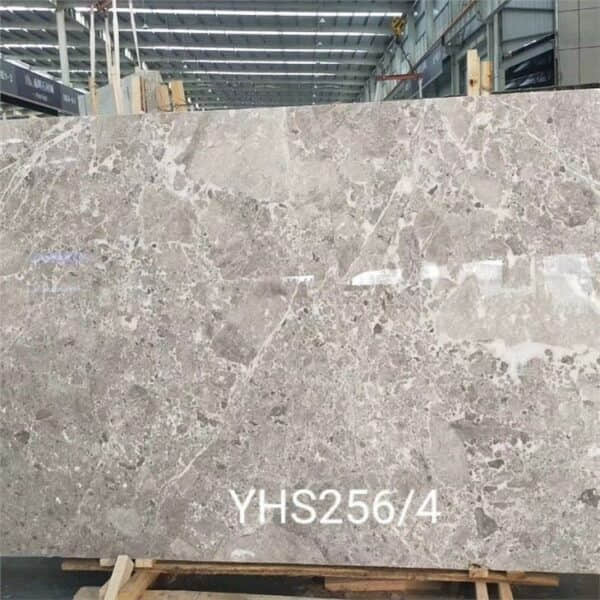
Procuring Athens Grey marble—frequently documented in international shipping manifests as Athena Grey marble slab—demands understanding its geological extraction, linear veining characteristics, and structural reinforcement requirements. Quarried in southwestern China, this stone has established itself as one of the most reliable commercial grey marbles in global architectural specification. Its visual hallmark is an understated mouse-grey to ash-grey calcitic groundmass traversed by crisp, parallel white and pale grey linear veins that deliver a tailored, contemporary neutral backdrop for commercial hospitality, corporate headquarters, and high-end residential interiors.
From a commercial procurement standpoint, Athens Grey offers substantial advantages in quarry block availability, large-scale bundle consistency, and competitive pricing compared to European grey marbles like Grigio Carnico or Pietra Grey. However, because it is a bedded sedimentary-metamorphic stone cut predominantly against the geological grain, successful delivery across high-volume projects depends on strict block selection, vein orientation management, consecutive book-matching, and proper resin reinforcement.
While our grey marble general guide covers the broad spectrum of international grey varieties, performance ratings, and selection criteria, this single-variety technical guide focuses exclusively on Athens Grey. Here, we outline its exact mineralogical composition, visual grading tiers, vein-cut versus cross-cut dynamics, surface finishes, installation best practices, and ocean transport safeguards for B2B buyers.
Geological Origin, Nomenclature, and Veining Typologies
Athens Grey is quarried primarily in Guizhou and Jiangxi provinces in China. Geologically, it is a calcitic marble formed through low-grade regional metamorphism of bedded marine limestone. The base grey coloration originates from finely dispersed carbonaceous and bituminous organic matter trapped during sedimentation, while the signature white striations represent pure recrystallized calcite veins that filled structural micro-fractures during tectonic shifting.
In global trade documentation, buyers encounter several synonymous commercial names. Athens Grey and Athena Grey refer to the exact same geological deposit, representing alternative phonetic transliterations of the trade name. Occasionally, suppliers list this material as Wooden Grey or Grey Serpeggiante due to its parallel striations. However, true Athens Grey features sharper, cleaner linear calcite veining with a cooler ash undertone, distinguishing it from warmer, brown-tinged wood-vein limestone marbles.
The aesthetic character of finished slabs is determined by how quarry blocks are oriented on industrial gangsaw beds:
- Vein-Cut (Linear Cut): Blocks are sawn perpendicular to natural geological bedding planes. This exposes the linear calcite strata, producing continuous parallel stripes running along the length of the slab. Vein-cutting accounts for more than 85% of commercial export production and is mandatory for book-matched feature walls and directional floor corridors.
- Cross-Cut (Fleuri / Cloud Cut): Blocks are sawn parallel to geological bedding planes. This yields a cloudy, mottled grey pattern with soft white blooms rather than directional lines. While less common, cross-cut Athens Grey is specified for monolithic flooring layouts where linear joint alignment would be difficult to maintain across wide areas.
Standard Slab Specifications, Finishes, and Reinforcement
Industrial processing facilities cut Athens Grey blocks using multi-wire diamond gangsaws calibrated for dense calcitic stone. First-choice gangsaw slabs typically measure between 2400mm and 2900mm in length and 1400mm to 1800mm in height, providing generous surface yields for architectural cut-to-size programs.
Export specifications center on two calibrated thickness tiers:
- 18mm and 20mm Slabs: The global commercial standard for vertical wall cladding, elevator cab linings, bathroom wall panels, and interior flooring. Thin calibrated slabs reduce dead load on subfloors and wall-anchor brackets while optimizing container weight limits.
- 30mm Slabs: Specified for executive reception desks, vanity countertops with laminated or solid profiles, and commercial stair treads requiring structural rigidity across unsupported spans.
Surface finishing dictates optical reflectivity and color perception. A high-gloss polished finish (exceeding 85 GU) is the standard commercial choice, intensifying contrast between the ash background and white linear veins. A honed finish (20 to 35 GU) produces a smooth, satin matte appearance that softens veining and eliminates glare, making it popular in boutique hotel guestrooms and modern corporate corridors. Brushed or leathered finishes utilize abrasive polymer wire brushes to gently erode softer calcite veins, yielding an antiqued, tactile texture with enhanced slip resistance in powder room entries.
Because natural marble contains micro-fissures along calcite vein boundaries, every commercial Athens Grey slab undergoes factory resin treatment. Slabs are thoroughly dried, vacuum-infused with low-viscosity clear epoxy resin to bond microscopic voids, and backed with a 100g to 140g/m² fiberglass reinforcement mesh. This structural backing is required to protect slabs during bridge saw cutting, waterjet fabrication, and container transport.
Athens Grey Marble Physical Property Benchmarks (Tested per Batch / Grade)
- Bulk Density (ASTM C97 / EN 1936): 2.65 to 2.72 g/cm³ (tested per batch to verify mineral density).
- Water Absorption Rate (ASTM C97 / EN 13755): Under 0.15% to 0.35% by weight (tested per batch; low open porosity for calcitic marble).
- Compressive Strength (ASTM C170 / EN 1926): 95 to 145 MPa in dry state; reduces by approximately 10% to 15% when saturated (tested per batch / per grade).
- Flexural Strength / Modulus of Rupture (ASTM C880 / EN 12372): 9.0 to 14.5 MPa, depending heavily on whether stress is applied parallel or perpendicular to calcite vein striations (tested per batch).
- Mohs Surface Hardness: 3.0 to 3.5 across calcitic matrix; easily scratched by hardened steel and sensitive to acidic food spills.
- Abrasion Resistance (ASTM C241 / EN 14157): Moderate; suitable for medium commercial interior foot traffic when protected by walk-off entrance mats.
Architectural Applications: Feature Walls to Interior Flooring
Athens Grey marble delivers exceptional visual cohesion when deployed across comprehensive interior finish schedules. When specifying an Athens grey marble slab bundle for vertical feature walls, architects frequently select book-matched pairs. Consecutive slabs are polished on opposing faces (Face A and Face B), allowing mirror-imaged white veins to create chevron or diamond patterns across lobby focal points and executive boardroom walls.
For horizontal surfaces, selecting premium blocks of Athens grey marble allows fabricators to produce elegant vanity countertops, reception desk facades, and furniture console tops. Specifiers must note that like all calcitic marbles, Athens Grey is sensitive to acidic chemicals such as lemon juice, wine, and aggressive toilet cleaners. It is ideally suited for hotel guestroom vanities and commercial powder rooms when treated with a high-performance penetrating impregnator, but should be avoided in heavy-duty commercial food preparation kitchens.
In high-traffic commercial spaces, installing calibrated Athens grey marble tiles in modular formats—such as 300×600mm, 600×600mm, or 600×1200mm—creates a continuous, modern floor plane. For linear vein-cut tiles, installers must dry-lay pieces prior to setting to ensure consistent vein direction. Use premium white-cement polymer-modified thinset mortars to eliminate dark moisture shadowing through the stone matrix.
Procurement Pitfalls: Vein Drift, Micro-Fissures, and Packing
Sourcing large volumes of Athens Grey requires vigilant factory oversight to avoid common processing flaws:
1. Vein Angle Drift and Density Imbalance: Within a single quarry block, linear veining can shift from crisp horizontal lines to diagonal or wavy waves over a 50cm cutting depth. Slabs from opposite ends of a block can display noticeably different white vein density. Overseas buyers should never purchase Athens Grey on the basis of small hand samples alone. Insist on high-definition full-bundle photographs and dry-lay inspection sign-offs before crating.
2. Micro-Fissures and Mismatched Resin Fills: Natural calcite veins occasionally harbor microscopic cleavage separations. Unscrupulous processing mills sometimes use poorly tinted polyester mastic to fill surface cracks, which discolors into yellow or pinkish lines after installation. Mandate the use of UV-stable epoxy resins color-matched to the natural ash-grey groundmass under natural daylight.
3. Tile Thickness Calibration and Edge Chipping: Due to the stone's moderate hardness, high-speed tile cutting saws can cause micro-spalling along sharp edges. Ensure tiles are calibrated to ±0.5mm thickness tolerance with a clean 1mm micro-bevel along perimeter edges to eliminate lippage and edge chipping during installation.
4. Export Crating and Ocean Transport Security: Slabs must be packed vertically on fumigated ISPM-15 certified wooden A-frames, separated by 2mm closed-cell polyethylene foam sheets to prevent transit scratching. Cut-to-size tiles must be packed into heavy seaworthy wooden crates lined with waterproof plastic sheeting, strapped with galvanized steel bands, and braced securely inside 20-foot containers to withstand ocean vessel pitching.
Frequently Asked Questions
Are Athens Grey and Athena Grey the exact same marble variety?
Yes. Athens Grey and Athena Grey are identical commercial names for the same Chinese calcitic marble quarried primarily in Guizhou and Jiangxi provinces. The variation in naming arises from different English transliterations used by export trading companies. Both names denote a cool grey background with linear white calcite veining.
Can Athens Grey marble be used for kitchen countertops?
Athens Grey is not recommended for high-traffic residential or commercial kitchen countertops. As a calcitic marble with Mohs hardness between 3.0 and 3.5, it reacts chemically with acidic substances like vinegar, citrus juice, and wine, resulting in surface etching and dull spots. It is, however, widely specified for bathroom vanities, reception desks, and decorative furniture when sealed with a penetrating fluoropolymer impregnator.
How do contractors ensure precise book-matching across consecutive Athens Grey slabs?
Precise book-matching requires ordering consecutive slabs extracted sequentially from the same quarry block, polished in alternating mirror pairs (Face A / Face B). Before installation, contractors must perform a factory dry-lay or digital CAD layout to align the white calcite veins across vertical seams, confirming consistent angle and line continuation across the entire feature wall.
What sealing schedule is recommended for Athens Grey marble flooring?
For commercial lobbies and hotel corridors, apply a breathable solvent-based penetrating sealer immediately after installation and grout curing. High-traffic commercial floors should be re-sealed every 12 to 18 months, while light-traffic residential installations typically require resealing every 24 to 36 months to prevent staining from foot traffic and dirty mop water.


