Onyx
Onyx, as the stone trade uses the name, is a translucent banded stone formed mainly of calcite or aragonite. Commercially classified and traded alongside marble in architectural procurement, onyx stands out for its parallel banding and optical translucency. We supply onyx sourced from quarries across Iran, Pakistan, Turkey, Afghanistan, Brazil, Chile, India, and China. Our inventory spans white, honey yellow, green, blue, pink, beige Maya, multi-color rainbow, and red wood grain palettes. Slabs are processed primarily in 16–20 mm and 30 mm thicknesses, with select 40 mm formats and bookmatched pairs available for symmetrical panel installations.
Onyx is specified primarily for high-impact vertical and feature installations where backlighting activates its natural crystallization, including hotel reception backdrops, illuminated bar counters, feature walls, luxury bathroom vanity cladding, and bespoke furniture tops. Because onyx pricing varies based on color rarity, crystalline translucency, block yield, and surface reinforcement, prices are calculated on a project basis. To receive a detailed quotation, send us your required color selection, target dimensions, quantity, and destination port.


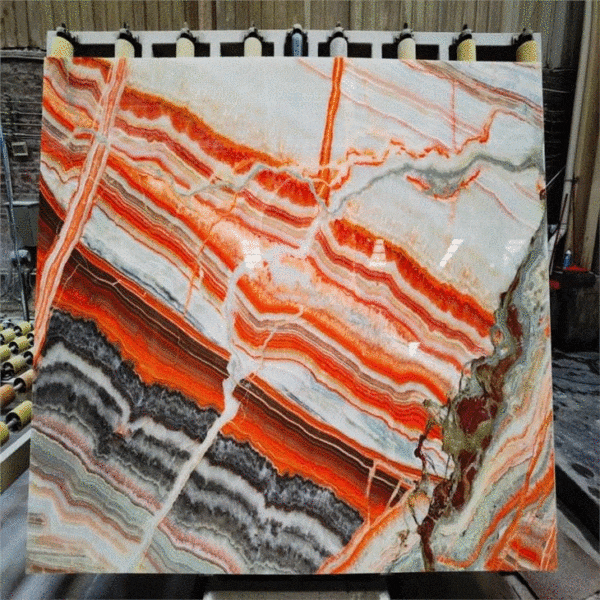


Rainbow Onyx Marble For Interior Decoration


Buying guide
Choosing an onyx colour and origin
Onyx offers a distinct architectural identity defined by parallel banding and crystalline transparency. Our onyx range covers the main colour families. White selections include White Onyx, Turkey White Onyx with veins, White Jade Onyx from Afghanistan, and Natural Translucent, detailed in our white onyx guide. Warm tones feature Honey Onyx and Onyx Yellow. Green varieties comprise Green Onyx, Dark Green Indian Onyx, Jade Onyx, and Chile Jade. Accent selections include Blue Onyx, Fantasy Blue, Pink Onyx, Beige Maya Onyx, Red Wood Grain Onyx, and multi-toned options such as Rainbow, Colorful, and Iran Colorful Jade.
These materials originate from active quarries across Iran, Pakistan, Turkey, Afghanistan, Brazil, Chile, India, and China. Because formation conditions vary across deposits, blocks extracted under identical commercial names can show differing background tones and vein structures. Project teams should review high-resolution photographs of individual bundles prior to dispatch.
Slab formats, thickness and bookmatching
Onyx is processed primarily in two thickness categories: 16–20 mm and 30 mm, with select 40 mm formats for monolithic details. Slabs measuring 16–20 mm represent the standard format for wall cladding and backlit vertical features, minimizing dead load while maximizing optical transmission. For horizontal vanity tops and reception counters, 30 mm slabs provide added rigidity.
Bookmatched slabs are consecutive cuts from one block polished on opposite faces to create symmetrical mirror patterns across adjoining seams. This format is standard for hotel lobbies and feature walls requiring balanced visual patterning.
Resin, mesh backing and why onyx needs it
Geologically, onyx precipitates from mineral spring waters, forming natural cleavage planes and micro-fissures. Because untreated onyx is fragile during extraction, sawing, and transport, resin impregnation and rear fiberglass mesh are standard practice for most onyx slabs.
Processing facilities apply vacuum-assisted epoxy resin to penetrate fine fissures and bond the crystalline matrix. A fiberglass reinforcement mesh adheres to the reverse side for handling and CNC cutting. During procurement, buyers should verify resin formulation and mesh placement to ensure compatibility with their installation method.
Backlit onyx: what to specify
Translucency depends on mineral density, crystal structure, and slab thickness. Light transmission varies from one variety and one block to the next, and thinner slabs generally pass more light, so judge each candidate material with a backlit sample rather than by colour alone. Detailed technical parameters are covered in our onyx backlit panel guide for interior lighting.
When specifying backlit panels, the reinforcement method is a key parameter. Standard fiberglass mesh backing is opaque; under rear illumination, the mesh pattern and dark adhesive lines will cast shadows through the translucent face. Specifiers must request transparent epoxy backing or specify mechanical edge framing so that light distribution remains uniform. Furthermore, teams evaluating horizontal surfaces should consult our onyx countertops buyer guide to review wear resistance and lighting placement.
What drives onyx slab prices
Onyx is a specialty architectural stone traded on individualized slab valuations rather than uniform commodity rates. Understanding commercial cost factors enables project managers to budget accurately when reviewing proposals, as outlined in our natural stone quotation guide. Primary cost drivers include:
- Color rarity: Rarer colours and clean, even backgrounds typically cost more than more widely available varieties.
- Translucency: Clear crystalline structures with minimal opaque sediment layers receive premium classification.
- Slab dimensions and yield: Large, rectangular blocks producing high-yield slabs without corner defects are rarer and valued accordingly.
- Bookmatched symmetry: Matched pairs and four-piece sets with aligned veining require precise sawing and carry premium pricing over random bundles.
- Reinforcement quality: High-grade optical epoxy systems and custom backing treatments require specialized processing cycles.
- Order quantity: Full bundle and container orders benefit from packaging and freight efficiencies compared to broken bundles.
MOQ, lead time and samples
Minimum order quantities vary by onyx variety, extraction season, and inventory status. Slabs are typically packaged and shipped in reinforced wooden bundles. However, we accept small trial orders for private residences or focused commercial programs, allowing buyers to source specific slabs without committing to full container volumes. For order volume planning, refer to our natural stone MOQ guide.
Lead time for existing warehouse inventory is typically 15 to 25 days from deposit confirmation to container loading, allowing for final bundle inspection, fumigated crating, and export documentation. Custom cut-to-size dimensions or specialized edge fabrication require extended production windows. We recommend ordering material samples to inspect crystalline color depth and backlight behavior before confirming container orders, as detailed in our stone sample request evaluation guide.


